Before you can build your first Excel formula, you need to know the basic vocabulary: what's a cell, a workbook, a worksheet, or the fill handle? This tutorial walks you through the essential Excel terms you'll see again and again throughout this series.
The Excel working environment
When Excel opens, you will see the following elements displayed on the screen:
- The worksheet, or the grid
- Each intersection of a row and a column is a cell
- The cell with the thick border is the active cell. This is where you'll write text, a number, or a formula.
- The letters A, B, C… are the column headers.
- To move around a spreadsheet, you can use the horizontal and vertical scrollbars.
- A zoom function is available to enlarge or reduce the display of the spreadsheet.

The highlighted rectangle in the screenshot above is a cell — the basic building block of any worksheet.
Above the grid, you'll find these items:
- The formula bar. Here, you can see whether a cell contains a value, a date, or a formula.
- The Ribbon. This is where you'll find all the tools you need to work in Excel.
- Tabs, or menus. Above the ribbon sit different task categories. Selecting one changes the icons and tools shown in the ribbon.
- The Name Box. It shows the reference of the active cell — or its custom name, if you've given it one.
- The Quick Access Toolbar. Pin your favorite commands here to save time — no more hunting through menus.
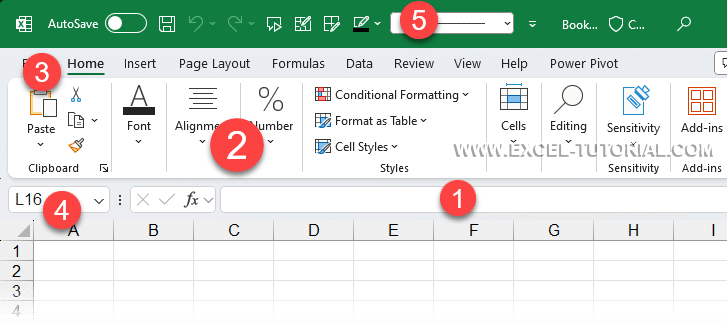
whether a cell contains a value, a date, or a formula.
Other essential Excel terms
A few more essential words will come up throughout this series.
- The square at the bottom right of the active cell is called the fill handle.

- Selecting several cells at once creates what's called a range of cells.

- An Excel file is called a workbook.
- A workbook can contain one or several worksheets (also called tabs).

Text or number?
One reason Excel is so powerful is that a single cell can hold almost any type of data:
- Text
- A number
- A date
- A logical test (TRUE or FALSE)
- And even images

Knowing which data type you're dealing with matters — text, for example, can't be used in a calculation.
Tips to recognize the data type of a cell
- Text is always on the left of a cell (B1, B2, B3, B4, B5, B6, B7, C1, C2)
- A number or date is always positioned to the right of a cell (C3, C4, C5)
- Less importantly, a logical test (TRUE or FALSE) is always in the center of a cell (C6)
Quiz
Continue learning
Keep building your Excel skills with the rest of this tutorial series:
- Tutorial - Adjusting the Size of rows and columns
- Tutorial - How to make calculations in Excel
- Tricks to Insert, Delete, Hide Rows and Columns
- Tutorial - All Excel tricks to Copy-Paste
- Tutorial - Moving cells or columns with the mouse
- Tutorial - The Numbers Format
- Tutorial - Excel Alignment text tips
- Learn the secrets of Sorting Data with Excel
- Excel Tutorial - Filtering your data
- Manipulate Text in Excel without formula
- Excel Tutorial - Creating a dropdown menu
- Learn how to use the SUM function in Excel
- Tutorial for the Excel Functions AVERAGE, MIN, and MAX
- Learn how to use the Dollars in an Excel formula


