Performing a calculation in Excel
To tell Excel that you want to perform a calculation, start by typing the = symbol.
- This way, Excel will understand that it needs to perform a calculation.
- Without the = sign, Excel interprets your writing as text.
In the following example:
- In C3, we perform a calculation but only see the result. Cell D3 shows the formula written in C3, i.e. =1+2, and the result, 3.
- In C5, we also wrote 1+2 but without the = sign, so for Excel it's just text, and the calculation isn't performed.

Simple operations
Excel is extremely simple to use, which is one reason it's so popular 😉.
As we just saw, all you need to do is start with the = sign, then write your operation using the following operators:
- + for addition
- - for subtraction
- * for multiplication
- / for division
Here are a few examples:

As you can see, the order of the numbers matters for some operators:
- Subtraction and Division: the order of the numbers is important to avoid errors
- Addition and Multiplication: the order of the numbers has no impact on the result
Worked example: which operator comes first?
What is the result of the following calculation?

Mathematical priorities
In mathematics, however, operators don't all have the same "weight". In order of priority:
- Exponent (or Power)
- Multiplication and Division
- Addition and Subtraction
In other words:
- The exponent will always be calculated first.
- Then comes the multiplication or division calculation.
- Finally, addition or subtraction.

For the first calculation, why is the result 20?
- First, the multiplication is calculated, i.e. 5*2 = 10.
- Then the addition: 10 (the previous result) + 10 = 20.
For the second calculation:
- First, the multiplication is calculated, i.e. 5*2 = 10.
- Then the addition: 20 - 10 + 20 = 30.
Using parentheses
However, you can override the order of operations by using parentheses.
When part of a calculation is enclosed in parentheses, that part is computed first.

In example 3:
- First, 20/5 = 4 is calculated.
- Then 5*5 = 25.
- And finally 4+25 = 29.
In example 4:
- First, the bracketed calculation 5+5 = 10 is done.
- Then the division 20/10 = 2.
- Then 2*5 = 10.
As you can see, the result can be completely different if you use or omit parentheses in your calculations.
Using cell references
The real advantage of doing calculations in Excel is that you can build formulas using cell references. This way, Excel knows to use the cell's contents in the calculation.
For example, to calculate the total including VAT, you add the total excluding VAT and the VAT amount:
- Enter the = sign.
- Select cell C2 using the mouse or the keyboard arrow keys.
- Add the + sign.
- Select cell C3.
- Confirm with the Enter key.
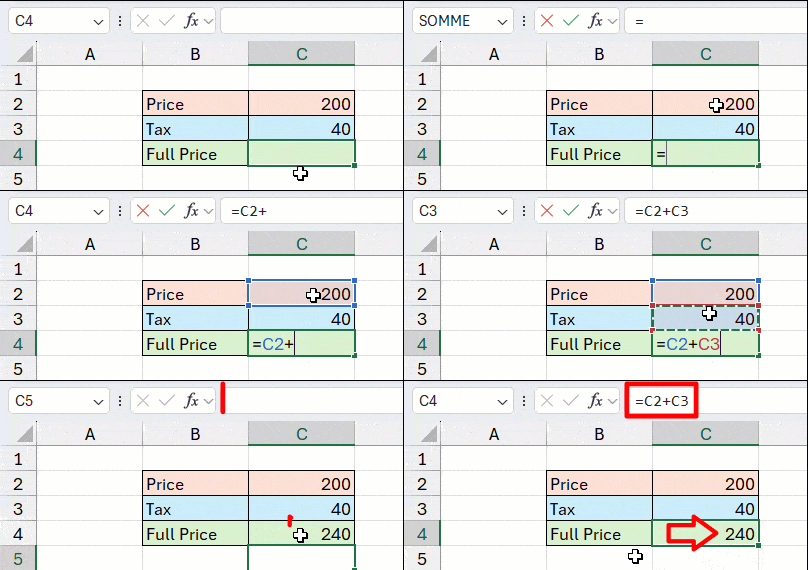
The formula bar shows =C2+C3, but the cell displays 240 (200 + 40).
What happens when you change one value?
In this example, the tax amount and the total price both depend on the price excluding tax:
- =C2*0.2 — the tax amount

- =C2+C3 — the total price

Now, if we change the initial price in C2:
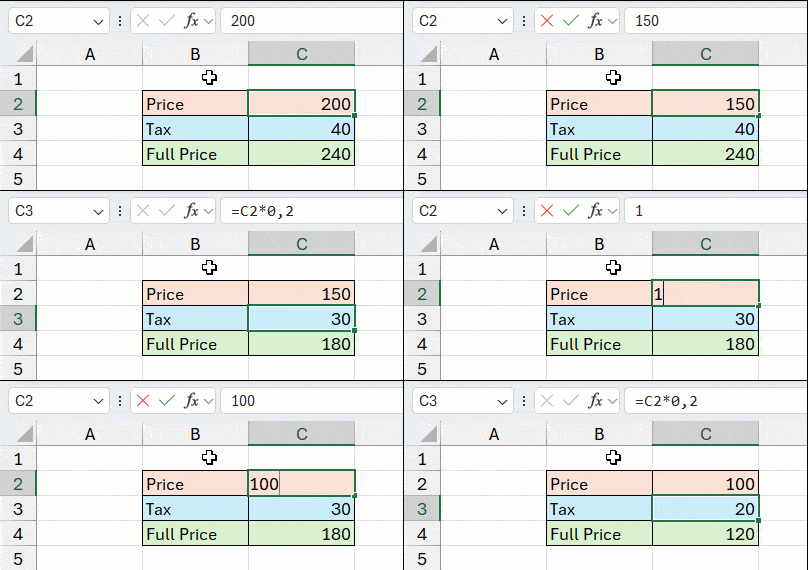
As you can see, Excel immediately recalculates the results in C3 and C4.
THAT'S WHAT EXCEL IS ALL ABOUT
When the value of a cell is changed, all the formulas linked to that cell are updated immediately 😀👍.
Now practice it yourself
Time to put these arithmetic operators to work: build your own formulas with +, -, * and /, and see how operator priority and parentheses change the result.
Continue learning
Keep building your Excel skills with the rest of this tutorial series:
- Tutorial - Excel keywords
- Tutorial - Adjusting the Size of rows and columns
- Tricks to Insert, Delete, Hide Rows and Columns
- Tutorial - All Excel tricks to Copy-Paste
- Tutorial - Moving cells or columns with the mouse
- Tutorial - The Numbers Format
- Tutorial - Excel Alignment text tips
- Learn the secrets of Sorting Data with Excel
- Excel Tutorial - Filtering your data
- Manipulate Text in Excel without formula
- Excel Tutorial - Creating a dropdown menu
- Learn how to use the SUM function in Excel
- Tutorial for the Excel Functions AVERAGE, MIN, and MAX
- Learn how to use the Dollars in an Excel formula


